

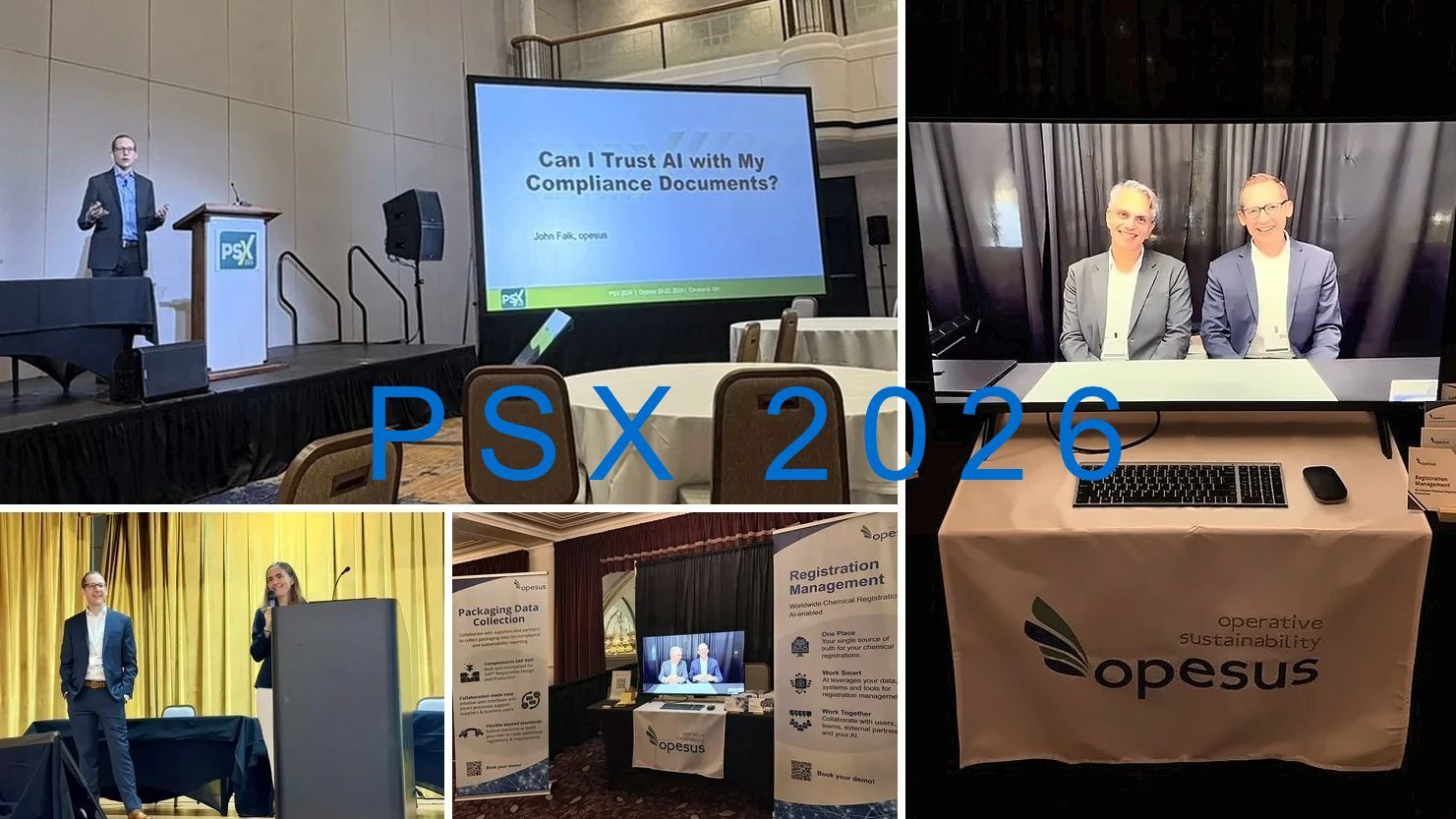
The Product Stewardship Society hosted PSX 2026 in Cleveland, Ohio from October 20th through 22nd. opesus was a product sponsor of the event and we came to share, not just to listen. John Falk took the stage twice.
Milestone Year for PSX
PSX 2026 was a special edition for the community. It was the first PSX run independently by the Product Stewardship Society. The conference brought together experts from more than 25 industry sectors to exchange practical insights on regulatory affairs, hazard communication, product sustainability, and product safety.
John's two presentations shared one message: technology only pays off when the data model, process, and ownership behind it are clear.
Talk 1: Can I trust AI with my compliance documents?
John’s answer – Yes, with the right controls built into your process. Getting there takes more than a good model.
Any AI tool can pull ten fields from one clean PDF in 30 seconds. Real compliance work looks different: tens of thousands of safety data sheets, study reports, registration dossiers, and supplier declarations. They arrive as scans, faxes, Word and Excel files, in dozens of languages and templates.
One company John referenced holds more than 50,000 study reports alone. At that scale, an extraction error is not just a data quality issue. It can become a compliance or safety issue. Take, for example, 50,000 reports with 20 data points each or 1,000,000 records in total. At 98% accuracy, that means 20,000 values are potentially wrong. Reviewing these values is going to be the expensive part.
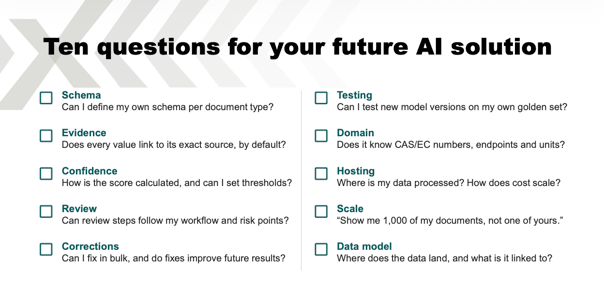
To wrap up the presentation, John provided a list of questions that should be considered when evaluating a potential AI solution for compliance documents:
Talk 2: Who owns EPR anyway?
EPR rules have existed for 35 years, and the number of schemes has grown to roughly 80 worldwide. For years, EPR was a minor local tax handled with flat fees and rough weight estimates. Today, SKU-level reporting and eco-modulated fees turn it into a regulatory framework that forces changes in product design and supply chains. And with the EU PPWR, packaging becomes a regulated product in its own right.
Often, within an organization, it is unclear who owns EPR, even though it touches business, procurement, IT, supply chain, sustainability, packaging, and product stewardship.
John and Marianne Heckmann laid out a clear path to compliance to manage EPR with clear milestones:
-
Familiarization and baseline: a trained core team and an overview of legacy EPR obligations

- Governance and ownership: clear accountability, your legal role per market, exemptions checked, budget secured
- Registration and reporting setup: PRO registrations, authorized representatives, all internal datasets collected
- Data and software: a reliable central system for packaging, logistics and EPR content, plus a supplier data process
- Immediate packaging compliance: heavy metals, PFAS in food contact materials, empty space, weight and recycled content, all documented
- Documentation, conformity, and labeling: an audit-ready technical file and signed DoC per packaging SKU
- Ongoing adjustments: minimizes fees, optimize materials, reduce manual work
Let's continue the conversation
In the two talks, whether extracting values from thousands of study reports or reporting packaging data in every market you sell in, the bottleneck is the same. You need a data model that gives every value a home, a process that defines what “correct” means, and clear ownership of who acts on it. AI can accelerate every one of these steps.
Missed PSX 2026 and would like to dig deeper? John would be happy to hear from you and discuss AI-supported document extraction or your EPR and PPWR roadmap in SAP. Setup a time to chat.