
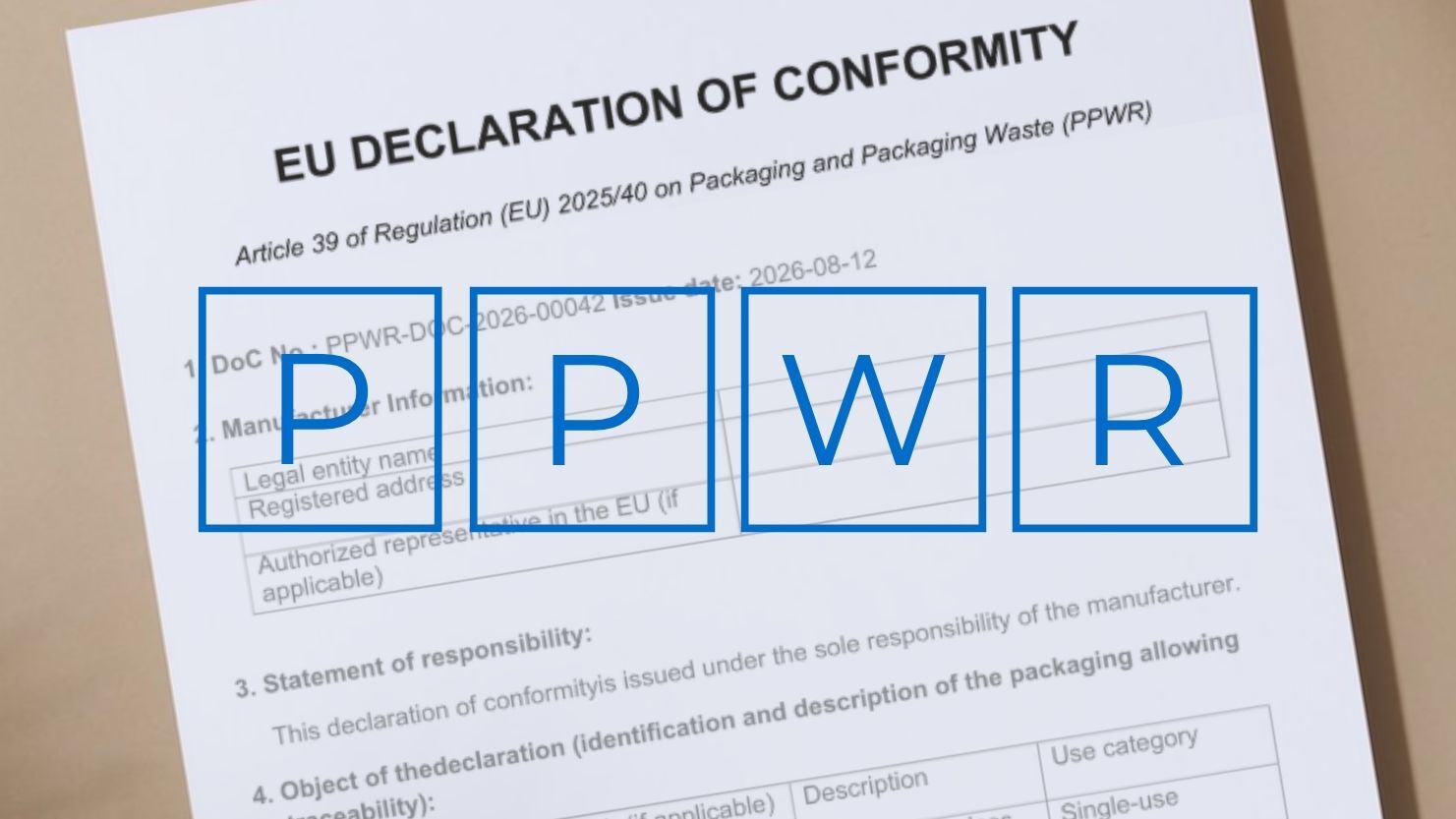
Now that the PPWR has moved from regulatory text to active obligations on 12 August 2026, one of the very first things every manufacturer must have ready is a Declaration of Conformity (DoC) for each packaging unit they place on the EU market. The DoC itself is short. The work behind it is not.
The honest picture across industries is that the first DoCs are being issued on imperfect data. For most companies, supplier coverage is not complete, test reports for every restricted substance are not realistic in the time available, and the analytical methods for some substances are not even fully defined yet. The pragmatic question is therefore not how to make the first DoC perfect, but how to make it defensible.
This article walks through what the DoC is, who has to issue it, what it has to contain, and what it takes to back it up.
For a broader introduction to the EU Packaging and Packaging Waste Regulation (PPWR), see our PPWR overview article: The EU PPWR Is Already Here: What You Need to Know and Why It Matters. For a strategic view of where to start by August 2026, see the previous article PPWR Compliance by 12 August 2026: A Pragmatic Roadmap for the First Regulation Milestone.
What the Declaration of Conformity Is and Where It Sits in PPWR
A Declaration of Conformity is a formal, signed statement by which the manufacturer takes sole responsibility for confirming that a specific packaging it’s compliant with the applicable PPWR requirements, in particular the sustainability requirements set out in Articles 5 to 12. The same logic appears across other EU product legislation, so the pattern will feel familiar to anyone who has worked with other EU product compliance frameworks such as RoHS or REACH.
The PPWR keeps the assessment and the declaration logically separate:
- How to evaluate compliance: the conformity assessment procedure set out in Article 38 and detailed in Annex VII.
- How to demonstrate compliance: the DoC itself, set out in Article 39 and with its content specified in Annex VIII.
Article 15 links both obligations directly to the manufacturer: The manufacturer must define and carry out the conformity assessment procedure referred to in Article 38 (or have it carried out on its behalf) and, where compliance has been demonstrated, draw up and sign the DoC.
The procedure under Annex VII is Module A, internal production control: the manufacturer assesses conformity itself, with no notified body and no third-party certification in the general case. Compliance strength therefore comes from the technical file behind the DoC, and the burden of demonstrating it rests entirely on the manufacturer.
A DoC is therefore not just paperwork. It is the visible outcome of a much larger conformity assessment procedure, and it travels with the packaging through the supply chain.

Who Issues the DoC, and What It Has to Cover
Who has to sign the DoC
The obligation to issue and sign the DoC sits with the “manufacturer” as the PPWR defines it. The legal definition is broader than the everyday meaning of the word: it captures the economic operator that designs the packaging, or has it designed, and places the packaged product on the EU market under its own name or trademark. The Commission’s recent interpretative guidance places the design element at the center of the test. The test most often points to the brand owner, even when a third-party converter physically produces the packaging.
It is also a definition with disputed cases ahead of it. The question of who the manufacturer is in complex supply-chain configurations may ultimately be settled by the Court of Justice of the EU, and the legal definition will keep maturing as it does. For now, the broadly accepted working answer for August 2026 is to treat the brand owner as the manufacturer.
Adjacent roles:
|
Importer Importers must verify that the non-EU manufacturer has performed the conformity assessment and issued the DoC, and must hold a copy themselves. They act as manufacturers and must issue their own DoC when they rebrand or repack the imported products. |
Distributor Distributors do not normally issue the DoC but need to verify that manufacturer or importer identification obligations have been met and that labeling is compliant. They become the manufacturer for compliance purposes if they repack, rebundle or rebrand. |
Service Packaging Provider Service packaging providers and reuse pool operators may end up on the responsible-operator side for their specific packaging, depending on who controls the design. |
What the DoC has to contain
Annex VIII sets out the structure, and it’s shorter than its weight suggests.
A Declaration of Conformity covers:
- A unique identification of the packaging
- Identification of the manufacturer and, where relevant, the authorised representative
- A statement that the declaration is issued under the manufacturer's sole responsibility
- Identification and description of the packaging that allows traceability, i.e. precise enough (format, materials, dimensions) to trace it back to its technical file
- Statement of conformity with the relevant Union harmonization legislation (i.e. any other Union acts applied)
- References to the standards or technical specifications used to substantiate compliance
- The notified body details where applicable (rare for packaging, since Module A requires none)
- Additional information, plus date, place and signature
A few practical points worth flagging:
|
1 |
|
2 |
| 3 Multi-act consolidation is allowed Where the same packaging falls under several EU acts that each require a declaration, a single consolidated document is possible. |
|
4 |
|
5 |
How to Prepare to Issue Your First DoC: The Conformity Assessment and the Technical File
The DoC is the easy bit. Most of the lift is in the conformity assessment that has to precede it. Article 15 places this duty on the manufacturer, and Annex VII sets out the procedure and the expected contents of the technical documentation:
- General description of the packaging
- Materials used
- Standards or technical specifications applied
- Calculations
- Test reports
In line with the Commission's guidance, it is the manufacturer who has to set up the actual procedure and decide what counts as sufficient technical documentation, within the limits of the Annex. This responsibility cannot be delegated. Testing and the assessment can be run by a laboratory, and an authorised representative can help with the declaration, but the technical documentation itself has to be drawn up and held by the manufacturer, not a supplier or a service provider.
What will be accepted in practice is still open. In practice, a full test report for every packaging type is not realistic, and unlikely to be the only proof expected. For many requirements, a supplier declaration (for example, confirming the packaging stays below the PFAS limits) or a technical data sheet should be enough to support the technical documentation.
This will likely carry most of the weight, though practice will ultimately set the bar.
A few practical realities are worth flagging up front:
-
Bulk supplier responses: Suppliers often send one document covering many materials at once; a single declaration may list hundreds of material numbers. The conformity assessment process needs to handle that without forcing one questionnaire per material.
-
Validation is non-negotiable: A consistent view across the industry is that supplier answers always need internal validation, with a clear accept or reject decision and an audit trail behind it. Certifying the supplier response, even where the underlying evidence is a statement rather than a test report, is what makes the file defensible later.
-
Templates kept simple: Keep the supplier facing template “very basic”. A short form, often just a statement or even a tick-box confirming the absence of substances of concern, could potentially be enough for many cases.
- The technical file is a living document: It has to stay current for as long as the packaging is on the market and through the applicable retention period. Five years for single-use packaging. Ten years for reusable packaging.
Practical starting points before issuing your first DoC:
|
1 |
| 2 Define the conformity assessment procedure that will precede each DoC, and pilot it on one or two packaging units to surface the real bottlenecks. |
| 3 Map your existing data against Annex VII and close the gaps before the DoC can be issued. |
| 4 Decide the DoC level for each packaging family, that is, how many units each declaration covers, letting your shipping model and existing data structures (such as the material master) drive a level you can realistically generate and maintain. |
| 5 Define how the DoC and the technical file behind it will be stored, versioned and retrieved when authorities or relevant third parties ask. |
Closing the packaging data gap behind the conformity assessment procedure is exactly what opesus Packaging Data Collection is built for: structured collection and validation of packaging data and technical files from suppliers and internal stakeholders, moving packaging, compliance and sustainability teams from recurring follow-ups to a standardized, audit-ready process. The collected data then flows automatically into SAP® Responsible Design and Production for the structured generation of Declarations of Conformity.
Conclusion
The DoC is short. The work behind it is not. Companies that start now, confirming who is the manufacturer for each packaging unit, designing the conformity assessment that precedes the DoC, and structuring the supplier data behind it, will issue DoCs as a routine output of an existing process. Some interpretation points will keep maturing in the months ahead, but waiting for full certainty is not a strategy. The first DoC will not be the final version. It needs to be defensible enough to support market access on day one and flexible enough to evolve with the regulation.