

The 12 August 2026 milestone is the first real test of PPWR readiness, and with the deadline approaching, many companies are still trying to translate the regulation and the recently published Commission Guidance into a workable compliance plan. The honest picture is that not every interpretation point is fully resolved yet. Implementing acts, harmonised standards and national enforcement approaches are still to come. But enough of the framework is already solid to act on.
Across industries, one pattern is unmistakable: PPWR pressure is already real. Compliance teams are fielding supplier requests in many different formats. Sustainability managers are still working out what “sufficient evidence” means for demonstrating compliance with the PPWR sustainability requirements. What the conversations keep coming back to is the same framing: August 2026 needs a defensible strategy, not a strategy that waits for full regulatory certainty.
This article outlines the obligations that activate on 12 August 2026, where the open questions and main uncertainties still sit, and how companies can build a practical, defensible PPWR compliance strategy that is solid on the essentials and resilient to what is still being clarified.
For broader context on the EU Packaging and Packaging Waste Regulation (PPWR), see our blog article The EU PPWR Is Already Here: What You Need to Know and Why It Matters.
What Activates on 12 August 2026
The first major PPWR obligations entering into application on 12 August 2026 are the substance restrictions for packaging placed on the EU market. They include the long-established restrictions on heavy metals (lead, cadmium, mercury and hexavalent chromium) carried forward from the Packaging and Packaging Waste Directive (PPWD), alongside restrictions on PFAS in food-contact packaging. The direction of travel is already familiar from other EU and national regulatory developments: regulators increasingly expect stronger control over hazardous substances in packaging materials.
From 12 August 2026 onward, packaging that does not comply with the applicable requirements can no longer legally be placed on the EU market. The same date brings the manufacturer marking obligations in Article 15 into force, requiring the manufacturer’s name, address and contact details, plus a type, batch, serial number or other identifier, on every packaging unit. In practice, we expect that many manufacturers will ask their packaging suppliers to apply these markings on their behalf, but the legal responsibility will remain with the manufacturer.
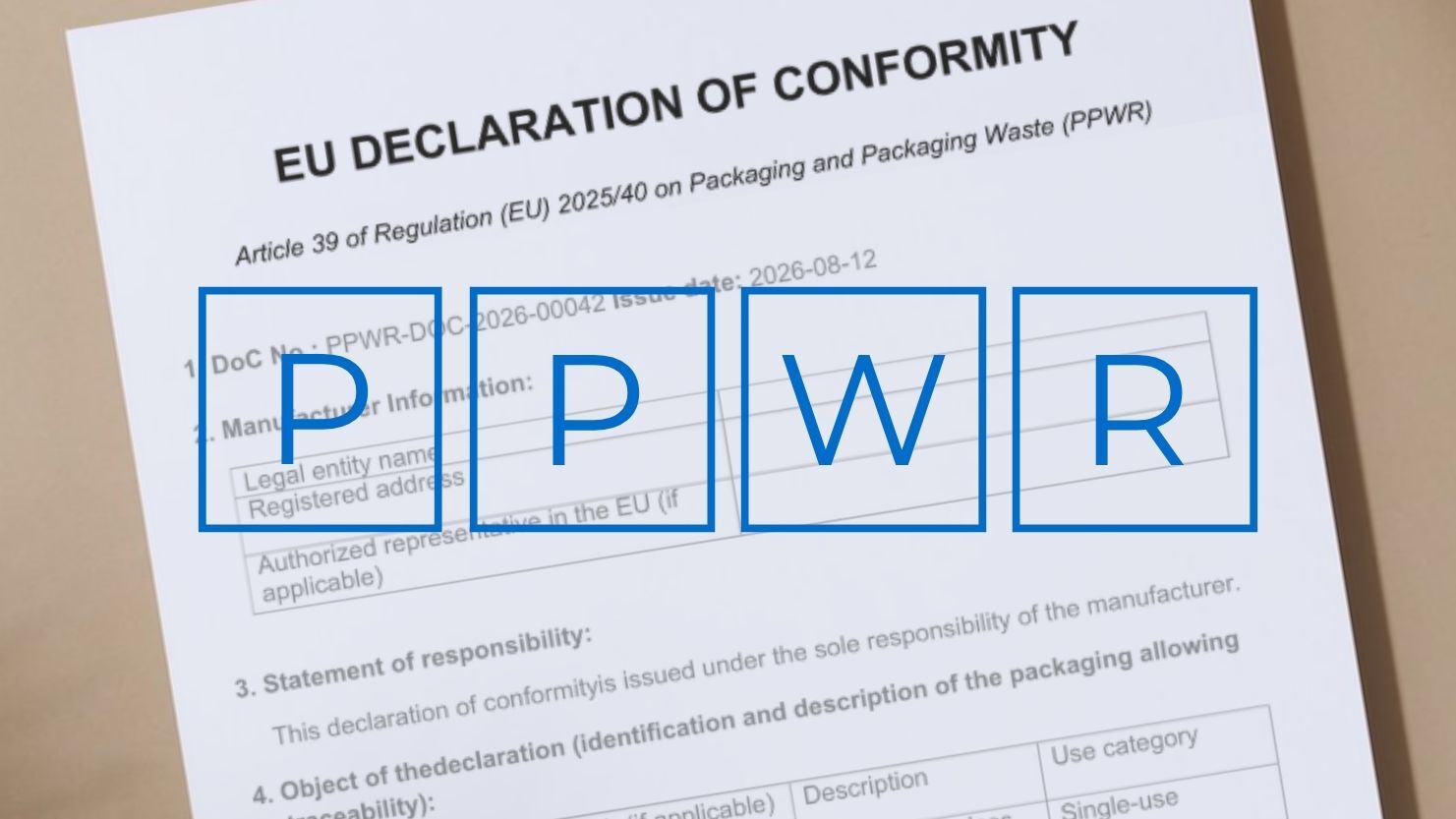
For each affected packaging unit, manufacturers must complete the conformity assessment procedure set out in Article 38 and Annex VII before issuing the signed Declaration of Conformity (DoC) required under Article 39 and Annex VIII. These are not optional administrative steps. They are core legal obligations linked directly to market access. Our next blog article in this series, The EU Declaration of Conformity under PPWR: What Manufacturers Must Issue from August 2026, will take a closer look at the DoC.
The responsibilities themselves are anchored primarily in Article 15, which defines the obligations of manufacturers under the PPWR. Article 16 creates a parallel obligation for packaging suppliers: suppliers must provide the information and documentation the manufacturer considers necessary to support the conformity assessment. That distinction matters operationally. The manufacturer carries the regulatory accountability, but in practice compliance depends heavily on supplier cooperation and reliable upstream data flows.
The Commission’s recent Guidance provides a useful interpretation anchor for companies trying to operationalise these requirements. It does not, however, resolve every open question. Several practical details, including the expected depth of technical documentation to support the conformity assessment procedure described above, will become clearer over time as further implementing acts, harmonised standards and other legal instruments are adopted, and as the competent national authorities harmonise their enforcement approach. The implication is straightforward: uncertainty still exists, but not at a level that justifies delaying preparation.
Building a Strategy When Some Answers Are Still Open
Strategy does not have to wait for every implementing act to land. You can already build a defensible August 2026 plan today around four principles that hold regardless of how the remaining interpretation questions are ultimately resolved:
| 1 Define who the manufacturer is for each packaging unit
This is rarely a single answer across a multi-product portfolio. Different packaging configurations and bundled goods shift responsibility between economic operators. Get this right before anything else, because everything that follows depends on it. |
| 2 Prioritise by risk, not by volume
The obvious split is by substance scope. Heavy metals apply across the whole packaging portfolio. PFAS applies specifically to packaging in food contact. Beyond that, market relevance and consumer visibility, particularly for consumer-facing primary packaging, usually rank highest on the priority list. On the depth of evidence required from each supplier, Article 16 is explicit: both information and documentation are needed. One workable option could be to calibrate the mix to the risk profile of each packaging unit, using supplier statements as a starting point and considering technical data sheets for higher-risk packaging. In any case, the rationale for the calibration should be documented so it stands up to scrutiny by the competent national authorities. |
| 3 Treat compliance as a programme, not a project
A pragmatic starting point could be to establish the smallest defensible version of the conformity assessment process, technical documentation file and DoC framework for the packaging units already in scope by 12 August 2026, and then design it to evolve. Processes that can be re-run whenever packaging compositions or suppliers change, regulatory guidance evolves, or new implementing acts, harmonised standards or other legal instruments are published will hold up far better than processes built for a single audit. |
| 4 Treat data, not paperwork, as the bottleneck
The real bottleneck is supplier data: reliable, traceable and continuously maintainable information flows covering material composition, substance content, restricted-substance declarations, test reports, technical data sheets, recyclability information and supplier statements. Exactly the data that Article 16 entitles the manufacturer to ask for. Once a stable supplier data collection process is in place, the conformity assessment and DoC generation become significantly more manageable. |
Where Software Solutions Fit Into the Strategy
A spreadsheet-based approach may be sufficient for an initial pilot or a limited packaging scope. It does not scale to a full PPWR compliance programme. A full programme has to manage thousands of packaging units, multiple supplier tiers, version control across changing materials, long retention periods, auditability and repeatable conformity assessment workflows in one coherent system.
A software-supported PPWR strategy needs to achieve three things at once:
| 1 Operationalise the Article 15 and Article 16 dynamic
|
| 2 Make the conformity assessment repeatable Each packaging unit should be linked to its applicable PPWR obligations, the evidence supporting compliance, the underlying supplier information and the resulting DoC. This transforms conformity assessment from a static document exercise into a workflow that can be re-run. |
| 3 Connect the technical file to the Declaration of Conformity
|
This is exactly where opesus Packaging Data Collection fits into a PPWR compliance strategy. opesus PDC is designed to collect both information and supporting documentation from suppliers, structure the conformity assessment process behind each packaging unit, and maintain the connection between technical documentation and the resulting DoC directly inside your SAP system. SAP Responsible Design and Production extends the picture for downstream PPWR and EPR reporting such as recycled content claims, EPR fees and plastic taxes.
Conclusion
12 August 2026 is not the finish line for PPWR compliance. It is the starting line. Companies waiting for every implementing act, every harmonised standard and every interpretive detail to become fully settled will find themselves behind from day one.
The organisations in the strongest position by August will be those that have already settled four things: who the manufacturer is for each packaging unit, what their conformity assessment process looks like in practice, how supplier information and documentation flow into it, and how the resulting DoC stays linked to the technical file behind it. Full certainty is not a prerequisite for action. The regulation, the EU Commission Guidance and the existing legal structure already provide enough clarity to build a defensible, risk-based PPWR compliance strategy today, and to refine it as the regulatory framework matures.